South Pole
The South Pole, the southernmost point on the globe, is the ultimate destination of Captain Nemo's voyage aboard the Nautilus. Reached on March 21, 1868, after a perilous journey beneath the Antarctic Ice Bank, the pole represents the culmination of Nemo's ambition to conquer the last unexplored region on Earth. It is here that he asserts his absolute independence from humanity, claiming the entire polar continent in his own name and performing a ritual of sovereignty that seals his identity as a law unto himself.
The Journey to the Pole
The Nautilus's approach to the South Pole was a feat of extraordinary navigation. After crossing the Antarctic Circle, the ship encountered the impenetrable Ice Bank, a vast barrier of fused ice mountains. Rather than turning back, Captain Nemo proposed a radical plan: to dive beneath the ice shelf. He calculated that the submerged portion of the icebergs, which extended only about 300 meters down, could be cleared by the Nautilus, which could then navigate in the open water beneath the frozen surface. The ship submerged, its powerful pumps storing air under high pressure, and for forty hours it raced southward at twenty-six miles per hour, guided by the 52nd meridian. On March 19, after ascending through thinning ice, the Nautilus broke through to open sea, revealing a vast expanse of water dotted with sparse floes and teeming with birds and fish. The thermometer read 3° centigrade, a comparative springtime locked behind the ice barrier.
The Claiming of the Pole
On March 21, the day of the equinox, Captain Nemo led a party ashore to a volcanic peak to take his noon sights. The sun, seen only by refraction, appeared as a golden disk on the horizon. Using a chronometer, Nemo observed the orb until it was cut exactly in half by the horizon at noon, confirming that they stood at 90° south. In a solemn voice, he declared, "The South Pole!" He then recited a litany of previous explorers—from Gheritk in 1600 to Sir James Clark Ross in 1842—who had pushed ever farther south but never reached the pole. "Well now! In 1868, on this 21st day of March, I myself, Captain Nemo, have reached the South Pole at 90°, and I hereby claim this entire part of the globe, equal to one-sixth of the known continents." When Professor Aronnax asked in whose name he claimed it, Nemo replied, "In my own name, sir!" He unfurled a black flag bearing a gold "N" on its quartered bunting, and as the sun's last rays licked the horizon, he called out, "Farewell, O sun! Disappear, O radiant orb! Retire beneath this open sea, and let six months of night spread their shadows over my new domains!"
The Polar Landscape and Wildlife
The polar continent itself was a desolate, volcanic landscape. The soil consisted of reddish tuff, slag, lava flows, and pumice stones, with thin smoke holes emitting a sulfurous odor that indicated ongoing inner fires. Vegetation was limited to a few lichens, microscopic diatoms, and long purple and crimson fucus plants washed up by the surf. The beach was strewn with mollusks, including small mussels, limpets, and sea butterflies. The air, however, was superabundant with life. Thousands of birds—auks, sheathbills, sooty albatross with four-meter wingspans, gigantic petrels, and cape pigeons—crowded the rocks and filled the air with deafening calls. The shores and ice floes were crowded with marine mammals: seals of various species, including the giant sea elephant, and walruses with their long ivory tusks. These animals, having never dealt with man, showed no fear. The sea itself was rich with baleen whales—bowhead, humpback, and finback—which found refuge in these southern waters from relentless hunters.
Consequences and Aftermath
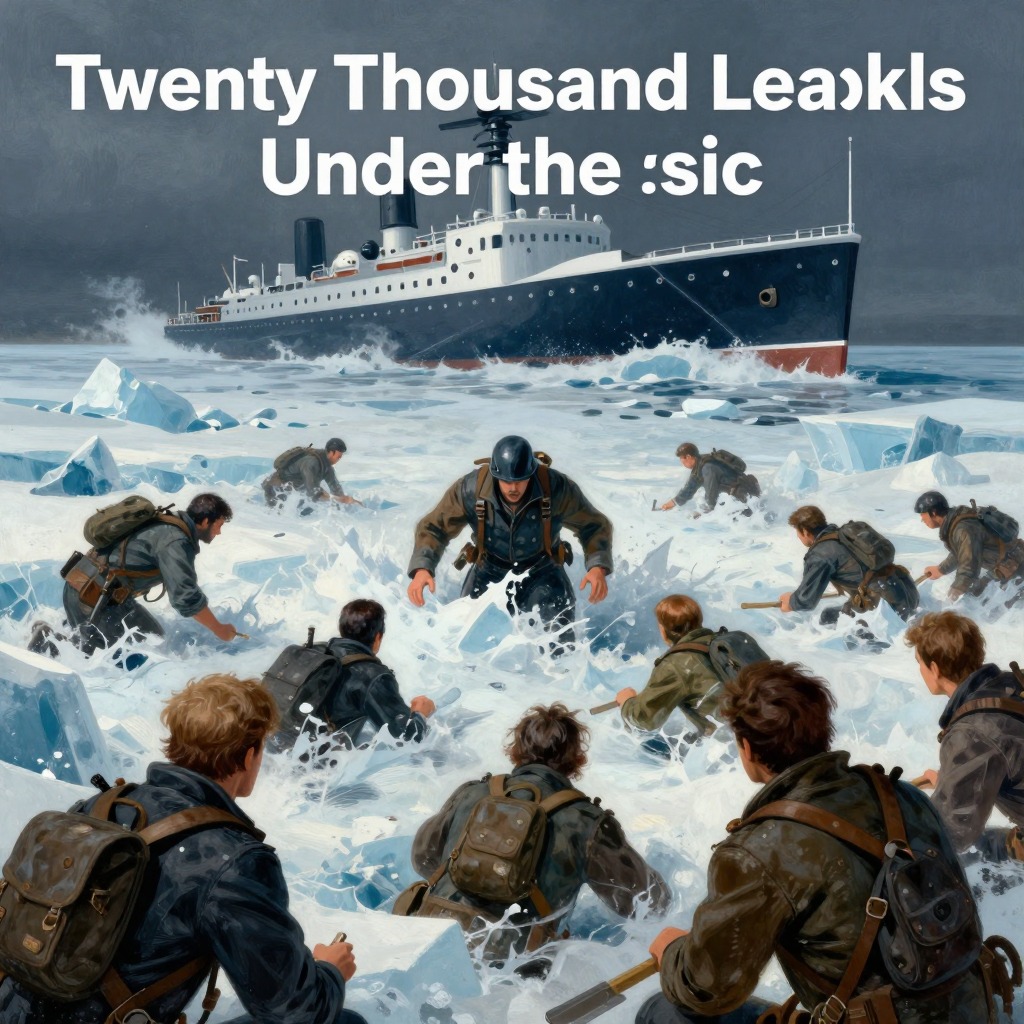
The triumph at the pole was immediately followed by a catastrophic reversal. As the Nautilus began its return journey northward beneath the Ice Bank, an enormous iceberg toppled over, trapping the ship in a narrow tunnel of ice. The walls began to close in, and the air inside the Nautilus grew foul. For six days, the crew worked desperately to dig through the ice, while Captain Nemo injected boiling water to delay the freezing of the surrounding sea. On the verge of asphyxiation, with the air tanks nearly empty, Nemo ordered the ballast tanks filled with 100,000 kilograms of water, causing the Nautilus to crack through the remaining meter of ice and shoot upward like a cannonball. The escape was a near-death experience that left the crew gasping for air on the surface. The South Pole episode thus encapsulates the dual nature of Captain Nemo: the visionary explorer who achieves the impossible, and the tragic figure whose hubris leads him and his ship to the brink of destruction. The black flag planted at the pole remains a symbol of his solitary, self-proclaimed sovereignty over a world he has chosen to inhabit alone.